
The Gandhi Memorial Society was established on December 17, 2017 to spread the message of truth, nonviolence, and love given to the world by Mahatma Gandhi — the moments below show that message in action.
Story of the month
Later in life, Gandhi was said to offer a simple test for anyone unsure whether an action was right: picture the face of the poorest, most vulnerable person you have seen, and ask whether the step you are about to take will do that person any good.
If the answer was yes, he believed doubt would begin to melt away — because the measure of any decision was its effect on the least powerful person it touched, not the most.
A simple test: will this action help the poorest and weakest, or only the strong?
More moments
Short, true moments from Gandhi's life — each one a small window into the values GMS carries forward.
Lorem ipsum dolor sit amet, consectetur adipiscing elit. Ut elit tellus, luctus nec ullamcorper mattis, pulvinar dapibus leo.
Story 01
As a teenager, Gandhi once did something he was deeply ashamed of and could not bring himself to say aloud...
Rather than confess in person, young Gandhi wrote his father a letter admitting what he had done and asking for punishment. His father read it in silence, wept, then tore it up and forgave him — never speaking of it again. Gandhi later said that quiet act of forgiveness taught him more about nonviolence than any lecture ever could.
Story 02
Boarding a train, Gandhi accidentally lost one shoe as it pulled away from the platform...
Rather than keep the single, now-useless shoe, Gandhi took off the other one and threw it onto the tracks near the first. When a fellow passenger asked why, he explained: a poor person who finds one shoe has nothing, but a person who finds a matching pair has something they can actually use.
Story 03
Before leaving India to study law in London, Gandhi made a quiet vow that would shape the rest of his life...
Gandhi’s mother worried about her son living abroad, so before he left he promised her he would avoid meat, alcohol, and women. He kept that vow throughout his time in London, even when it meant going hungry at dinners where no vegetarian food was offered — a discipline that stayed with him for life.
Story 04
Gandhi once traded his English suits for a simple, handspun cloth — and turned that choice into a movement....
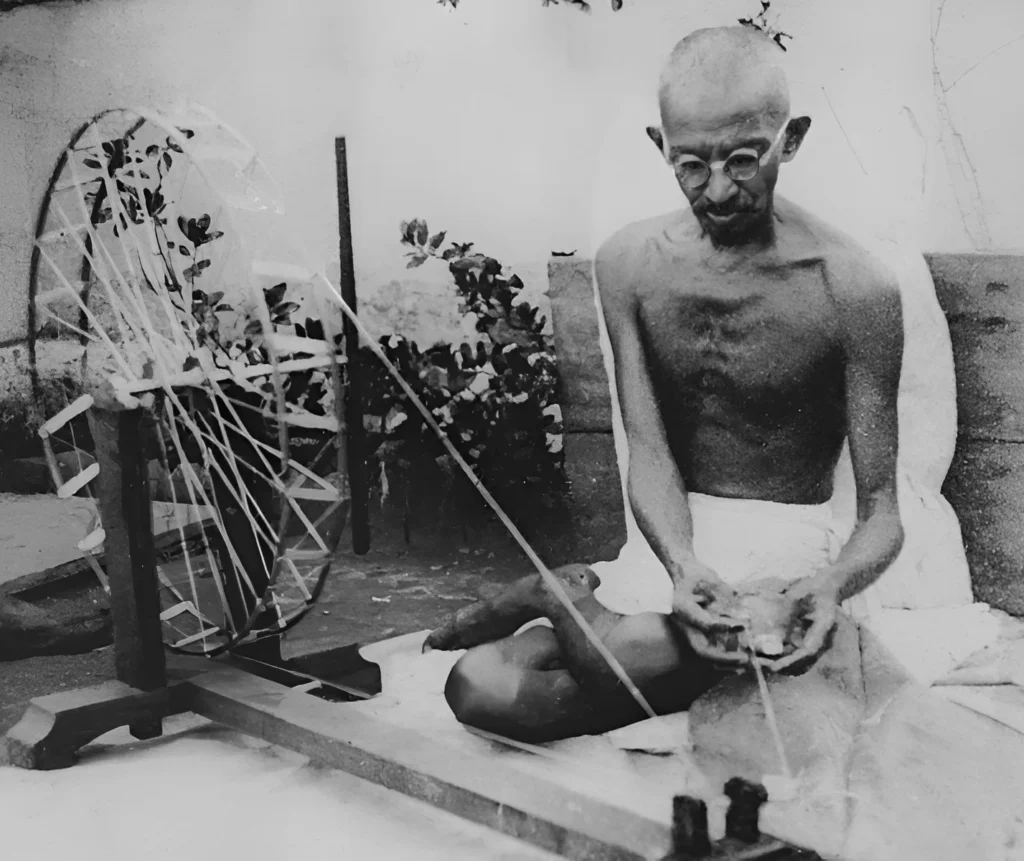
Gandhi began spinning his own cotton thread on a charkha, a simple spinning wheel, and wearing only khadi — homespun cloth. It became a quiet form of protest against British textile imports and a symbol of self-reliance that spread across India, encouraging millions to make their own cloth rather than depend on foreign goods.
Story 05
A single night on a South African railway platform changed the course of Gandhi's entire life...
Despite holding a valid first-class ticket, Gandhi was ordered to move to third class because of his race — and forcibly removed when he refused. He spent that cold night on the platform at Pietermaritzburg station deciding not to leave South Africa, but to stay and fight the injustice he had just experienced firsthand.
Story 06
Long before his assassination, Gandhi survived an earlier attempt on his life — and his response surprised everyone...
Gandhi was assaulted more than once over the course of his activism, yet he consistently declined to press charges or seek punishment for his attackers. He believed that meeting violence with legal retaliation was still a form of violence, and that real change came from refusing to answer hatred in kind.
Story 07
One of history's most famous protests began with something as ordinary as salt from the sea...
In 1930, Gandhi walked 240 miles to the Arabian Sea to make salt by hand, defying a British law that made it illegal for Indians to do so. The simple act — anyone could gather salt from the shore — became a powerful symbol that ordinary people, doing ordinary things together, could challenge an empire.
Story 08
The man who would one day address vast crowds started his legal career by freezing up in his very first case...
When Gandhi began practicing law in Bombay, he was so nervous during his first court case that he could not bring himself to cross-examine a witness and had to leave the courtroom. He later found his voice not in courtrooms, but in quiet, patient organizing — proving that leadership doesn’t always start loud.